
Introduction
If you’re based in North America and looking to build or scale a vehicle export business, the Middle East and Africa represent two of the fastest-growing and most underserved markets in the world. In 2025, U.S. containerized car exports to Africa jumped 92.4% year-over-year, while Middle East volumes climbed 20.6%—making these regions far and away the hottest destinations for American and Canadian vehicles.
The opportunity is real, but so are the complexities. Shipping a vehicle from Toronto or Houston to Dubai or Lagos is not simply a matter of putting a car on a boat. Between U.S. Customs and Border Protection (CBP) export regulations, Canadian Border Services Agency (CBSA) tax-exemption requirements, destination-country compliance rules, title restrictions, and volatile freight markets, there is a lot that can go wrong—and go expensively wrong—if you are not prepared.
This guide is written for entrepreneurs and business owners who are either entering the export market for the first time or looking to systematize and scale an existing operation. It covers every stage of the process: sourcing vehicles, clearing them for export, choosing the right shipping method, understanding what each market actually wants, calculating realistic profit margins, and protecting yourself from the most common and costly mistakes.
Why the Middle East and Africa? Understanding the Demand
The Middle East: A High-Value, Import-Friendly Market
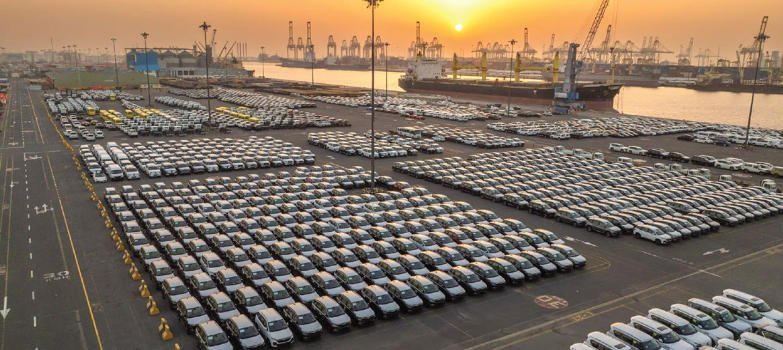
The Gulf Cooperation Council countries—Saudi Arabia, the UAE, Qatar, Kuwait, Bahrain, and Oman—collectively form one of the most open automotive import environments in the world. The standard import duty across GCC member states is just 5%, one of the lowest rates globally, and the UAE applies zero VAT on re-exported vehicles. The UAE, and specifically Dubai’s Jebel Ali port, has become the world’s leading automobile re-export hub, absorbing vehicles from North America and distributing them across East Africa, South Asia, and the broader Middle East.
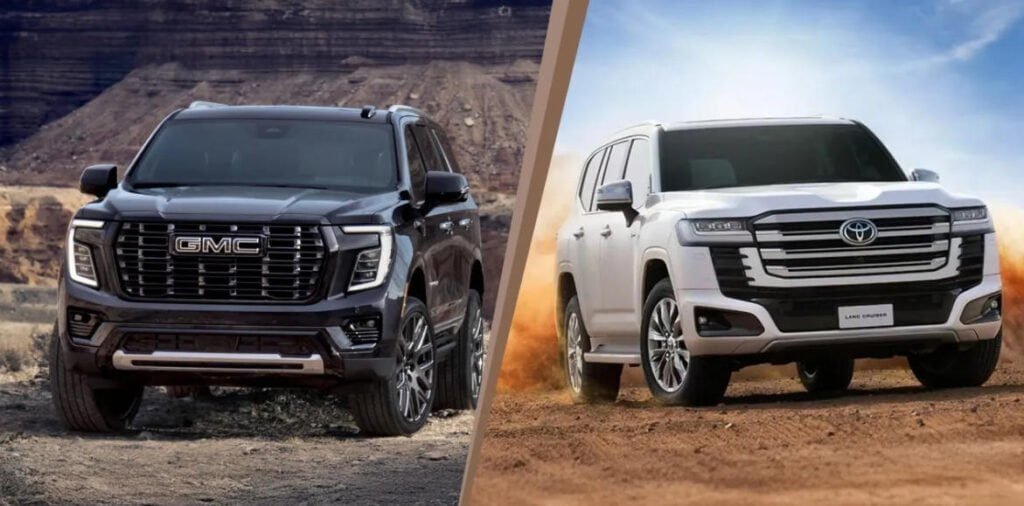
Consumer preferences in the Gulf lean heavily toward large SUVs, full-size pickups, and luxury vehicles. American-market trucks and SUVs—Ford F-150, Chevrolet Tahoe, GMC Yukon, RAM 1500—are significantly cheaper when sourced from the U.S. than when purchased locally. The same applies to used luxury vehicles: a well-maintained Cadillac Escalade or Lincoln Navigator purchased from a U.S. auction at $20,000–$30,000 can retail in the UAE for $45,000–$60,000 after shipping and duty.
For exporters, the UAE also functions as a staging ground. A container that arrives at Jebel Ali can be bonded in the free trade zone and then forwarded to Ethiopia, Kenya, Tanzania, or Uganda without paying full UAE import duties—making Dubai not just a destination but a distribution platform for the entire East African corridor.
Sourcing: Where to Find the Right Inventory
Auction Platforms: Copart and IAAI
The two dominant salvage and used vehicle auction platforms for North American export sourcing are Copart and IAA (Insurance Auto Auctions). Together, they process hundreds of thousands of vehicles every week across the United States and Canada, and both have established international buyer programs.
Copart is the larger of the two by volume and offers the widest variety of inventory—including run-and-drive used vehicles, salvage/insurance total losses, classic cars, fleet vehicles, and high-mileage units. International buyers tend to gravitate toward Copart when they are looking for volume, older model years, or unusual vehicle types.
IAA has built a reputation for cleaner, more recent inventory with lower average repair costs. For buyers who prioritize faster turnover—source, repair, re-sell within 60–90 days—IAA often offers better-condition vehicles with more predictable repair estimates. Post-sale logistics at IAA are also generally smoother for international buyers.
Both platforms allow international buyers to participate through licensed brokers, which is important for buyers without a U.S. dealer license. A broker bids on your behalf, charges a service fee, and handles the initial logistics from auction lot to port. For buyers scaling to larger volumes, obtaining a dealer license in a U.S. state with favorable requirements (Georgia, Florida, and Texas are commonly used) removes the broker dependency and reduces per-vehicle costs.
In Canada, the equivalent platforms are Impact Auto Auctions and ADESA Canada, with operations across Ontario, Alberta, British Columbia, and Quebec. Canadian auction inventory tends to have lower starting bids than comparable U.S. units, but export procedures differ (covered in the compliance section below).
Other Sourcing Channels
Beyond salvage auctions, established exporters also source from:
- Dealership trade-ins and off-lease fleets: Particularly relevant for clean-title, low-mileage vehicles destined for Gulf markets where title condition is scrutinized at customs. Fleet companies (rental car companies, government agencies) often sell in bulk at predictable price points.
- Manheim and other dealer-only auctions: Require a dealer license but offer the cleanest title vehicles at the best price relative to retail.
- Direct wholesale purchases: As your operation grows, relationships with fleet managers, dealerships, and insurance companies allow you to bypass auction fees entirely.
Understanding Vehicle Titles: The Most Critical Due Diligence Step
Title type is the single most important factor in determining where a vehicle can legally be exported and at what price it will clear customs. Getting this wrong can result in a vehicle being seized at port or rejected by a buyer—a $10,000–$40,000 mistake.
Title Types and Their Export Implications
Clean Title: The vehicle has no major damage history and has never been declared a total loss by an insurer. Clean title vehicles clear customs in virtually every market and command the highest resale prices. These are the preferred inventory for Gulf markets (UAE, Saudi Arabia, Qatar) and South Africa.
Rebuilt / Reconstructed Title: The vehicle was declared a total loss, repaired, and re-inspected. Many markets accept rebuilt title vehicles, but some—particularly Saudi Arabia—have tightened restrictions significantly in recent years. Always verify the current policy of your specific destination country before purchasing rebuilt title inventory.
Salvage Title: The vehicle has been declared a total loss and has not been repaired and re-inspected. Salvage title vehicles are significantly cheaper at auction and represent the highest-margin opportunity when exported to markets with less restrictive import rules. Nigeria, Ghana, and many East African countries accept salvage title imports. The UAE accepts them for re-export to third countries but generally does not register salvage-title vehicles locally.
Parts-Only / Non-Repairable: These vehicles are generally not exportable for road use and are only suitable for the scrap or parts market.
The critical rule is this: research the title policy of your destination country before bidding, not after. For the UAE and Saudi markets specifically, consult directly with your destination customs broker about current enforcement—policies in these markets can change with limited notice.
Export Compliance: USA vs. Canada
Exporting from the United States (CBP Requirements)
U.S. vehicle exports are regulated under Title 19 of the Code of Federal Regulations, Part 192 (19 CFR 192). The key requirements for used self-propelled vehicles are:
The 72-Hour Rule: The exporter must present both the physical vehicle and required documentation to U.S. Customs and Border Protection at the port of export no later than 72 hours before the vessel sails. This clock starts when physical documentation is presented to CBP—not when the Electronic Export Information (EEI) is filed through the Automated Export System (AES). Many first-time exporters confuse these two steps and miss their vessel.
Required Documentation:
- Original Certificate of Title (or a Certified Copy, with two complete copies)
- Vehicle Identification Number (VIN) matching the title
- Electronic Export Information filed via AES
- Commercial invoice (for customs valuation at the destination)
- Bill of Lading (issued by the carrier, not by a broker)
Anti-Theft Compliance: The primary driver of 19 CFR 192 is preventing the export of stolen vehicles. CBP will run VINs against the National Crime Information Center (NCIC) database. Vehicles with flagged VINs will not be permitted to export. Always run an NMVTIS report and a Carfax or AutoCheck before purchasing any vehicle for export.
AES Filing: An Electronic Export Information record must be filed for every vehicle export. Schedule B classification for used passenger vehicles is 8703.xx.xx. This is typically handled by your freight forwarder.
Exporting from Canada (CBSA Requirements)
Exporting vehicles from Canada involves the Canada Border Services Agency (CBSA) and adds a tax compliance layer that catches many dealers off guard: the Goods and Services Tax / Harmonized Sales Tax (GST/HST) exemption.
When a Canadian dealer sells a vehicle for export, they are not required to collect GST/HST—but they must be able to prove the vehicle actually left the country. The proof required is a legitimate Bill of Lading issued by a licensed carrier confirming the vehicle was loaded onto a vessel at a recognized Canadian port (Montreal, Halifax, Vancouver). A “house bill of lading” issued by a logistics broker before the vehicle is physically at the port is not accepted by the Canada Revenue Agency (CRA) as proof of export and can result in the dealer being assessed for uncollected tax.
The practical implication: do not release a vehicle to a buyer or agent until it has been physically presented to a licensed carrier at the port, and do not issue an invoice without tax exemption until you hold a verified bill of lading. The Used Car Dealers Association of Ontario (UCDA) has published clear guidance on this requirement.
Main Canadian Export Ports:
- Montreal (Port of Montreal): Primary East Coast export port; primary gateway for Europe and West Africa
- Halifax (Port of Halifax): Faster East Coast sailing times to the UK and West Africa
- Vancouver (Port of Metro Vancouver): Pacific gateway; longer sailing times to the Middle East and East Africa
Shipping Methods: RoRo vs. Container
Roll-On/Roll-Off (RoRo)
RoRo shipping is the most cost-efficient method for exporting running vehicles in high volume. Vehicles are driven onto the vessel, secured in the ship’s decks, and driven off at the destination port. There is no container to purchase or load.
Best for: Clean-title, running vehicles; high-volume shipments; destinations with established RoRo terminal infrastructure (UAE, Saudi Arabia, South Africa).
Typical transit times from U.S. East Coast:
- Jebel Ali, UAE: 25–35 days
- Mombasa, Kenya: 28–40 days
- Durban, South Africa: 25–32 days
- Apapa, Lagos, Nigeria: 20–28 days
Typical RoRo cost per vehicle: $800–$1,500 (U.S. East Coast to UAE or West Africa), including basic cargo protection. Note that standard automobile insurance does not cover international sea freight—you must purchase separate marine cargo insurance.
Limitations: Vehicles are exposed to the marine environment during transit. Non-running vehicles cannot be shipped via RoRo. Some smaller African ports do not have RoRo facilities, requiring a transshipment to a container.
Container Shipping
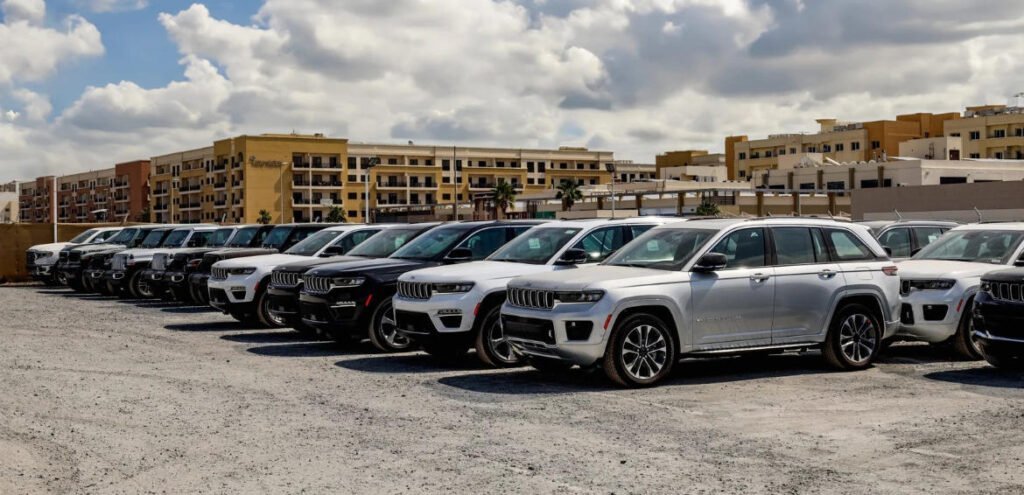
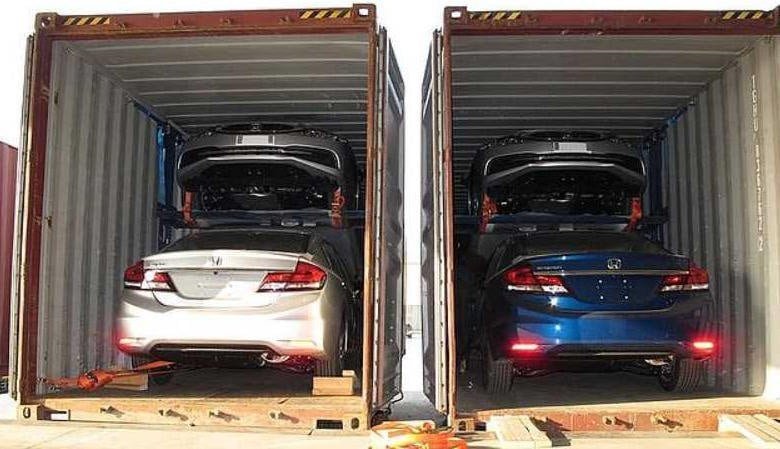
Container shipping places vehicles inside a sealed steel container (typically 40-foot High Cube). A single 40HC container holds 3–4 standard passenger vehicles, depending on their size and configuration.
Best for: Non-running or salvage vehicles; high-value vehicles requiring maximum protection; destinations without RoRo terminal access; shipments that include spare parts or accessories alongside the vehicle.
Typical container costs (40HC): $2,500–$5,000 total (U.S. to UAE or West Africa), carrying 3–4 vehicles. This works out to roughly $700–$1,600 per vehicle, comparable to RoRo for small batches, and cheaper per vehicle as you fill the container more efficiently.
Port selection matters: Choosing the right U.S. departure port significantly impacts both cost and transit time. For Middle East destinations, Baltimore, Savannah, and Houston are common choices. For West Africa, New Jersey (Port Newark), Baltimore, and Savannah are well-served. For East African routing via Jebel Ali, any major East or Gulf Coast port works.
The Jebel Ali Hub Strategy
Many experienced North American exporters use Jebel Ali (Dubai) not just as a final destination but as a logistics hub. Vehicles shipped to Jebel Ali’s free trade zone can be stored, inspected, repaired, and then re-exported to East African countries (Ethiopia, Uganda, Tanzania, Kenya) at lower freight costs than direct U.S.-to-East Africa shipments. This strategy also allows you to hold inventory closer to the end buyer and respond faster to specific buyer requests.
Country-by-Country Market and Compliance Guide
United Arab Emirates
The UAE is the most straightforward entry point for North American exporters entering the Middle East. Key requirements:
- Import duty: 5% on CIF (cost + insurance + freight) value
- Age restriction: Vehicles must generally be less than 10 years old for local registration; no restriction for re-export via free zone
- Title: Clean title strongly preferred for local registration; salvage acceptable for re-export
- Drive configuration: Left-hand drive only for local registration
- Popular vehicles: Toyota Land Cruiser, Lexus LX, GMC Yukon, Chevrolet Tahoe, Ford F-150, Cadillac Escalade
Saudi Arabia
Saudi Arabia is the largest GCC economy and a major buyer of U.S. vehicles, but it has become more complex in recent years:
- SASO/SABER certification: Vehicles must meet Saudi Standards, Metrology and Quality Organization (SASO) requirements; importers increasingly required to use the SABER platform for conformity verification
- Age restriction: Maximum 5 years old for most vehicle types
- Title: Rebuilt and salvage title vehicles face increasing rejection at customs; clean title is essential
- Drive configuration: Left-hand drive only
- Popular vehicles: Toyota Camry, Land Cruiser, Lexus, American full-size trucks (via specialty importers)
Nigeria
Nigeria is Africa’s largest market by volume and accepts a wide range of vehicle types and conditions:
- Import duty: 35% on CIF value (subject to periodic adjustment)
- Age restriction: 12 years maximum, enforced since 2025; vehicles older than 12 years from manufacture date are prohibited
- Title: Salvage and rebuilt title vehicles accepted
- Drive configuration: Right-hand drive is common but left-hand drive vehicles can be registered in most states
- Port: Apapa (Lagos) is the primary entry point; Onne port (Port Harcourt) is an alternative
- Popular vehicles: Toyota Camry, Honda Accord, Lexus RX, Toyota Sienna, Hyundai Sonata
Ghana
Ghana is West Africa’s second-largest market and a regional hub for landlocked countries (Burkina Faso, Mali, Niger):
- Import duty: 20% plus additional levies (total effective rate often 30–40%)
- Age restriction: 10 years from first registration (not manufacture date)
- Port: Tema port (near Accra) is Ghana’s primary vehicle import port
- Popular vehicles: Toyota Corolla, RAV4, Land Cruiser Prado, Honda CR-V
Kenya
Kenya is East Africa’s commercial hub and the gateway for Uganda, Rwanda, and parts of Tanzania and South Sudan:
- Import duty: 25% on CIF value, plus excise duty (varies by engine size) and VAT
- Age restriction: 8 years from first registration
- Drive configuration: Right-hand drive required
- Port: Mombasa
- Popular vehicles: Toyota Fielder, Premio, Allion, Land Cruiser; Nissan Note; Subaru Forester
South Africa
South Africa is Africa’s most developed auto market and the most complex to enter from North America:
- Import permit: An ITAC (International Trade Administration Commission) import permit is required for most vehicle imports
- NRCS certification: The National Regulator for Compulsory Specifications requires a Letter of Authority confirming the vehicle meets South African safety standards
- Duty: 25% customs duty plus 15% VAT
- Title: Clean title only; salvage vehicles face significant hurdles
- Drive configuration: Right-hand drive required
- Port: Durban (RORO terminal); Cape Town
Calculating Profit Margins: A Realistic Model
Understanding your true landed cost before making a purchasing decision is non-negotiable. The following is a typical cost model for a mid-range export vehicle:
Example: 2019 Toyota Camry XSE (Clean Title) to Nigeria
| Cost Item | Amount (USD) |
| Auction purchase price | $12,000 |
| Auction buyer’s fee | $750 |
| Tow/transport to port | $350 |
| Export documentation (CBP, title) | $150 |
| Ocean freight (container, shared) | $900 |
| Marine cargo insurance (1.5% of CIF) | $200 |
| Destination port handling (Apapa) | $300 |
| Customs duty (35% on $13,400 CIF) | $4,690 |
| Clearing agent fee | $400 |
| Total Landed Cost | $19,740 |
| Estimated retail sale price (Lagos) | $26,000–$28,000 |
| Gross margin | $6,260–$8,260 (32–42%) |
Example: 2020 GMC Yukon SLT (Clean Title) to UAE
| Cost Item | Amount (USD) |
| Auction purchase price | $32,000 |
| Auction buyer’s fee | $1,200 |
| Tow/transport to port | $400 |
| Export documentation | $150 |
| RoRo freight (U.S. to Jebel Ali) | $1,100 |
| Marine cargo insurance | $500 |
| UAE import duty (5% on $33,700 CIF) | $1,685 |
| Clearing agent (UAE) | $600 |
| Total Landed Cost | $37,635 |
| Estimated retail sale price (Dubai) | $52,000–$58,000 |
| Gross margin | $14,365–$20,365 (38–54%) |
These models assume clean-title, good-condition vehicles and do not include any repair or reconditioning costs. Salvage vehicles purchased from Copart or IAAI will have lower acquisition costs but require a repair cost estimate factored into the model before bidding.
Key margin drivers:
- Title quality: Clean title commands 20–40% higher retail prices than rebuilt
- Vehicle desirability in the destination market: A vehicle that matches local tastes (size, brand, drivetrain) will sell faster and at a higher price
- Auction timing: End-of-quarter and post-hurricane periods often produce undervalued auction lots
- Container consolidation: Filling a 40HC container to 4 vehicles spreads fixed freight costs and increases margin per unit
Payment and Financial Risk Management
Receiving payment from buyers in the Middle East and Africa involves risks that are absent in domestic transactions. The two most reliable methods for international vehicle transactions are:
Irrevocable Letter of Credit (LC): The buyer’s bank guarantees payment upon presentation of specific shipping documents (bill of lading, commercial invoice, certificate of origin). This is the gold standard for large transactions and provides the exporter with a bank-backed guarantee before the vehicle leaves port. LCs add cost (typically 1–2% of transaction value) and require precise document matching, but they eliminate counterparty risk.
Telegraphic Transfer (TT) in Advance: The buyer wires full payment before the vehicle ships. This is the most common method for smaller transactions and established buyer relationships. Require 100% payment before releasing the bill of lading—never ship documents separately from the vehicle to an unverified buyer.
Avoid: Western Union, informal payment apps, or any arrangement where you release the vehicle or title before confirming cleared funds in your account. Fraud targeting vehicle exporters is a well-documented risk, particularly with new buyers in West African markets.
Building Your Operation: From First Export to Scalable Business
Start with the UAE Market
For most North American entrepreneurs entering this business, the UAE is the recommended starting point. The regulatory environment is clear, English is widely spoken in business contexts, payment norms are professional (TT advance or LC), and Jebel Ali’s infrastructure is world-class. A single successful vehicle export to a UAE buyer is a complete proof of concept for your operation.
Find Your Buyer Before You Source the Vehicle
The most common mistake among new exporters is buying first and finding a buyer second. Inverted sourcing—identify a buyer with a specific vehicle request, then source that vehicle from auction—eliminates inventory risk and allows you to negotiate the sale price before you incur any costs. This is the operating model used by most professional export businesses.
Build Relationships with Freight Forwarders Early
A good freight forwarder who specializes in vehicle exports is one of the highest-value relationships in your business. They will handle AES filings, coordinate with CBP, book vessels, issue bills of lading, and manage the relationship with destination port agents. For U.S.-based operations, freight forwarders concentrated in Baltimore, Savannah, Houston, and New Jersey have the most established vehicle export expertise.
Licensing and Compliance
Operating a vehicle export business at scale in the U.S. typically requires a used dealer license in at least one state, which grants direct access to dealer-only auctions (Manheim) and eliminates the broker fee layer on Copart and IAAI. In Canada, the provincial dealer licensing regime applies; Ontario dealers must comply with OMVIC regulations regarding export sales and tax documentation.
FAQ(People Also Ask)
Q1: What documents and procedures are required to export a used car from the U.S. to the Middle East?
Exporters must submit the original vehicle Title or a Certified Copy to U.S. Customs and Border Protection and complete the document filing at least 72 hours prior to lading. The core materials required are the vehicle Title, VIN information, Commercial Invoice, Electronic Export Information via the AES system, and the Bill of Lading. The UAE and Saudi Arabia also require a Certificate of Origin.
Q2: What are the key differences between exporting a car from Canada versus the United States?
U.S. exporters must strictly comply with CBP’s 72-hour rule and AES filing requirements. Canadian exporters process exports through the CBSA, primarily using the ports of Montreal or Halifax, and they must possess an official Bill of Lading issued by the actual carrier to qualify for HST/GST tax exemption. A House Bill of Lading is not recognized by the Canada Revenue Agency for tax exemption.
Q3: Are there vehicle age and condition restrictions for exporting used cars to Africa?
Yes, regulations vary significantly by country. Nigeria enforces a maximum vehicle age limit of 12 years. South Africa requires NRCS certification and an ITAC import permit. Kenya limits vehicles to within 8 years of their first registration, and Ghana imposes a 10-year age limit. For comparison, the UAE and Saudi Arabia restrict vehicles for local registration to within 10 and 5 years respectively, but they have no age restrictions for vehicles in transit for re-export.
Q4: How long does it take to ship a car from North America to Dubai, and how much does it cost?
From the U.S. East Coast or Montreal to Jebel Ali Port in Dubai, RoRo shipping takes approximately 25 to 35 days and costs around $800 to $1,500 per vehicle including insurance. Container shipping takes approximately 30 to 45 days, where a 40HC container holds 3 to 4 cars with total freight costs ranging from $2,500 to $5,000.
Q5: Which is better for exporting to Africa: RoRo or Container shipping?
RoRo is best suited for volume exports of drivable, clean vehicles because it offers lower per-unit costs. Container shipping is ideal for non-runners or salvage vehicles, high-value cars, or destinations lacking RoRo infrastructure, which is common in inland Nigeria and certain East African ports. Currently, the majority of used cars exported to Nigeria, Ghana, and Kenya utilize container shipping.
Q6: What is the profit margin for exporting used cars from North America to the Middle East and Africa?
Profit margins vary heavily based on the specific model and market. A typical clean-title used SUV exported to Dubai yields a gross profit margin of approximately 38% to 54% upon arrival. A mid-range sedan exported to Nigeria yields a gross profit margin of about 32% to 42%. Key cost variables include the auction purchase price, buyer fees, ocean freight, destination customs duties like 5% in the UAE and 35% in Nigeria, and local clearing agent fees.
Q7: Which North American used car models are most popular in the Middle East and African markets?
The Middle East prefers large, 4WD, luxury-configured vehicles such as the Toyota Land Cruiser, Lexus LX, GMC Yukon, Ford F-150, and Chevrolet Tahoe or Suburban. Africa prefers reliable, fuel-efficient models like the Toyota Camry, Corolla, RAV4, and Sienna, the Honda Accord and CR-V, and the Nissan Altima. East African nations like Kenya require Right-Hand Drive vehicles.
Q8: Is it viable to use the UAE as a transit hub to export vehicles to other African countries?
Yes, it is completely viable and a highly mature business model. The Jebel Ali Free Zone in Dubai allows vehicles to be stored under bond and transshipped to East African countries such as Ethiopia, Kenya, Tanzania, and Uganda without paying UAE import duties. Many North American exporters establish partnerships with Dubai-based agents specifically to handle this redistribution.
Q9: What are the most common risks when exporting cars from North America to Africa and the Middle East?
The top risks include salvage titles failing to clear customs in strict destination countries, Canadian HST/GST exemption claims being denied due to non-compliant documentation like an invalid House Bill of Lading, and sudden, unannounced hikes in destination country customs tariffs. Other risks include physical cargo damage during transit, making separate marine insurance highly recommended, and buyer payment fraud. It is standard practice to wait until 100% of the wire transfer has cleared or to use a confirmed Letter of Credit before releasing original shipping documents.
Conclusion
Exporting vehicles from the United States and Canada to the Middle East and Africa is a mature, well-traveled trade route—but it rewards operators who understand its details. The exporters who build sustainable businesses in this market share a few common characteristics: they research destination-country regulations before buying inventory, they build relationships with specialized freight forwarders and destination agents, they structure their payments to eliminate counterparty risk, and they treat every shipment as a proof point for systematizing their next ten.
The market tailwinds are strong. U.S. and Canadian vehicles carry global brand recognition, transparent vehicle histories, and broad parts availability that buyers in the Gulf and across Africa actively seek. The question is not whether the demand is there—it is whether your operation is structured to capture it reliably and profitably.
This article reflects regulations and market data current as of May 2025. Import regulations, duty rates, and vehicle age restrictions are subject to change. Always verify current requirements with a licensed customs broker in your destination country before shipping.