
In the high-stakes world of luxury vehicle arbitrage, understanding the nuanced differences between Canadian Specification (Can-Spec) and United States Specification (US-Spec) is critical for maximizing profit margins and ensuring regional compliance.
As a premier North American export partner, CCE Auto Trade provides this technical breakdown to help global importers make data-driven procurement decisions.1. The Core Divergence: Metric vs. Imperial Systems
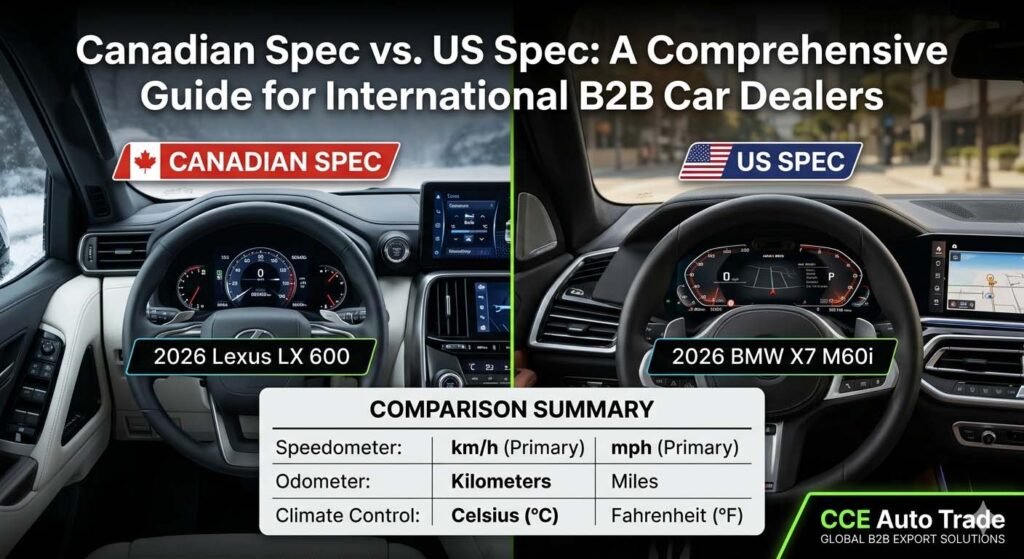
The most immediate distinction lies in the primary units of measurement.
Canadian Spec: Utilizes the Metric system. Speedometers display km/h as the primary scale, and odometers record distance in kilometers. Climate control systems default to Celsius.
US Spec: Utilizes the Imperial system. Speedometers prioritize mph, and odometers record miles. Climate control defaults to Fahrenheit.
B2B Insight: For markets in the Middle East (UAE, Saudi Arabia) and Central Asia (Kazakhstan, Uzbekistan), Canadian-spec vehicles are often preferred because they align with local metric standards, requiring zero cluster conversion.
Lighting & Safety Regulations
Both markets share rigorous safety standards (Transport Canada vs. NHTSA), but execution differs:
Daytime Running Lights (DRL): Canada has mandated DRLs since 1989. In many Canadian-spec luxury models (like the Lexus LX600 or BMW X7), the DRLs are hard-wired to be “always-on,” a feature highly valued for safety in diverse international terrains.
Cluster Warnings: Canadian specs often use ISO-standard symbols (e.g., the brake symbol (!) ), whereas US specs may use text-based warnings (e.g., “BRAKE”).
Cold Weather Packaging as Standard
Due to Canada’s northern latitude, vehicles destined for the Canadian market are frequently equipped with what US dealers consider “Optional Upgrades.”
Standard Luxuries: Features like heated steering wheels, heated rear seats, and remote engine starters are often standard on Canadian-spec trims (e.g., Mercedes-Benz GLE 63 S).
Battery & Fluids: Canadian units often feature heavy-duty batteries and engine block heaters, ensuring superior reliability for importers in colder climates like Mongolia or Northern Europe.
Documentation & Export Legality
For B2B trade, the “paperwork trail” is where deals succeed or fail.
MSO vs. Title: US vehicles typically come with a Certificate of Origin (MSO) or a Title. Canadian vehicles utilize a New Vehicle Information Statement (NVIS) and provincial registration documents.
Compliance Labels: Both specs feature a VIN plate on the dashboard and a compliance label on the driver-side door pillar. CCE Auto Trade ensures all VINs are cleared through the Canadian Border Services Agency (CBSA) for seamless international re-registration.
Resale Value & Market Perception
Inventory Availability: In the current 2026 market, certain high-demand models like the Lexus LX 700h or Ford Raptor R may have shorter waiting lists in Canada compared to specific high-demand US states like California or Florida.
Pricing Advantage: Depending on the USD/CAD exchange rate, sourcing from Canada often provides a significant FOB (Free On Board) price advantage for bulk buyers, even after factoring in logistics.
Summary: Which Spec Should You Choose?
| Feature | Canadian Spec | US Spec |
| Speedometer | km/h (Primary) | mph (Primary) |
| Odometer | Kilometers | Miles |
| Climate Control | Celsius (°C) | Fahrenheit (°F) |
| Cold Weather Kit | Usually Standard | Often Optional |
| Best For | Middle East, Central Asia, EU | South America, Caribbean |
Why Partner with CCE Auto Trade?
Navigating the border between Canadian and US supply chains requires more than just a buyer; it requires a logistics expert. Whether you are sourcing a fleet of Cadillac Escalade IQs or a single Porsche Carrera T, we provide:
VIN Verification & History Reports.
Secure Multi-Unit Container Loading.
Metric/Imperial configuration support.
Ready to upgrade your inventory?
[Contact CCE Auto Trade on WhatsApp] for our latest 2026 Price List and real-time inventory updates.