
Canada is one of the world’s most competitive markets for new vehicles. Full-size pickup trucks, large SUVs, and performance variants that are either unavailable or significantly more expensive in the UAE are sitting on dealership lots across Ontario, Alberta, and British Columbia — often with shorter wait times and lower all-in costs than GCC-market equivalents.
For buyers in the UAE — whether you are an individual looking for a North American-spec Ford F-150 Raptor, or a dealer building a portfolio of premium trucks for resale — the process of sourcing from Canada is more structured than most people expect. This guide walks you through every step, from selecting the right vehicle to taking delivery at Jebel Ali Port.
Why Source a New Vehicle From Canada?
The case for buying from Canada rather than through a local UAE dealer or a parallel importer comes down to four factors: model availability, price, specification, and trust.
Model availability. Certain vehicles are simply not sold in the GCC through official channels, or are sold in limited trims. The RAM 1500 TRX, certain Ford F-150 Raptor configurations, the Chevrolet Tahoe High Country, and the Cadillac Escalade-V are all easier to source in full specification from Canada than through any other channel.
Price competitiveness. Canadian MSRP on full-size trucks and large SUVs is often 10–25% lower than equivalent GCC-market pricing once you factor in the weaker Canadian dollar, absence of local dealer markups, and Canada’s HST/GST exemption on vehicles sold for export.
Specification transparency. Buying directly from a Canadian dealership means the vehicle’s build sheet, factory options, and kilometre reading are fully verifiable. There is no grey area around condition, trim level, or provenance.
Established logistics corridor. The Canada–UAE shipping route via Jebel Ali Port is a mature, high-volume lane. Transit times, documentation requirements, and customs procedures are well understood and predictable.

Step-by-Step: The Complete Export Process
Select and Confirm the Vehicle
Identify the exact make, model, trim, and factory options you want. Confirm availability with the supplying dealership or export agent. For high-demand models (Raptor, TRX, Escalade-V), expect a wait of 4–12 weeks if the vehicle needs to be ordered from the factory. In-stock units can move within 7–14 days of purchase.
Verify the Vehicle is Export-Eligible
Not all new vehicles can be exported immediately. Some manufacturers impose a minimum domestic ownership period before a vehicle can leave Canada. Your supplier should confirm the specific model is export-ready and that no manufacturer export restrictions apply to that VIN.
Agree on Price and Payment Terms
Purchase price is typically quoted in Canadian dollars (CAD). For B2B orders, payment is usually structured as a deposit to reserve the vehicle, with the balance due before shipment. Wire transfer (SWIFT/IBAN) is the standard method. Confirm whether HST/GST exemption applies to your purchase — for genuine exports, it should, which reduces the vehicle’s total cost by 5–15% depending on the province.
Pre-Shipment Inspection and Documentation
Before the vehicle leaves the dealership, a full pre-shipment inspection should be completed and documented — including photographs of all four sides, interior, odometer reading, and VIN plate. This protects both buyer and seller and is a requirement for UAE customs clearance. All accessories and original documentation (owner’s manual, second key, window sticker) must be included.
Arrange Ground Transport to the Port
The vehicle needs to travel from the dealership to the export port — typically Montreal (Port of Montreal), Halifax, or Vancouver depending on origin and destination. A licensed auto transport carrier handles this. Transit to port takes 3–7 days for most Canadian locations.
Book Ocean Freight — RoRo or Container
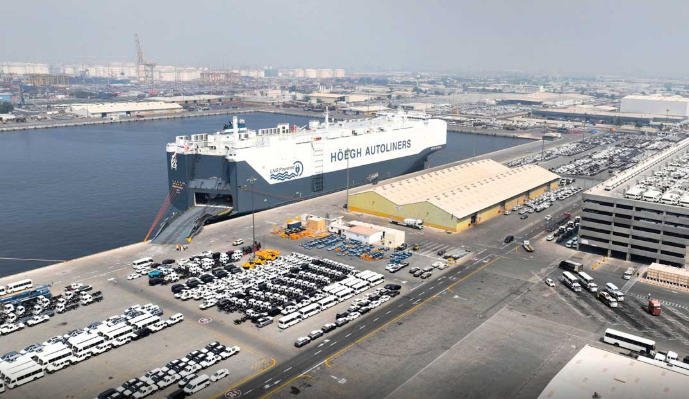
Two options exist for shipping. RoRo (Roll-on/Roll-off) is lower cost, faster to book, and widely used for standard vehicles. Container shipping is recommended for high-value vehicles (Raptor R, Escalade-V, RAM TRX) or when the buyer needs additional cargo packed inside. Transit time from a Canadian East Coast port to Jebel Ali is approximately 28–35 days.
Customs Clearance at Jebel Ali
Upon arrival in the UAE, the vehicle enters customs at Jebel Ali Port. UAE import duty on passenger vehicles is 5% of the vehicle’s CIF value (Cost + Insurance + Freight). A licensed customs broker handles the clearance process, which typically takes 3–7 working days once all documents are submitted correctly.
UAE Registration and Delivery
After customs clearance, the vehicle is registered with the RTA (Roads and Transport Authority). For North American-spec vehicles, a technical inspection is required to confirm compliance with UAE road standards. Once registration is complete, the vehicle can be driven or delivered to its final destination.
Documents You Will Need
Documentation is the part of the process that catches buyers off guard most often. Every document listed below is required — missing even one can delay clearance by weeks.
- Original Canadian Certificate of Title (in the exporter’s or buyer’s name)
- Bill of Lading — issued by the shipping line, confirming the vessel, route, and cargo
- Commercial Invoice — showing the vehicle’s purchase price in CAD and USD equivalent
- Packing List — detailing the vehicle’s VIN, make, model, year, and included accessories
- Pre-Shipment Inspection Report — with photographs, odometer reading, and condition notes
- Canada Export Declaration (B13A) — filed with the Canada Border Services Agency (CBSA)
- Certificate of Origin — confirming the vehicle was manufactured in North America
- Insurance Certificate — covering the vehicle during ocean transit
- Buyer’s UAE passport copy / Emirates ID (for individual buyers)
- Trade licence (for B2B / dealer importers)
Costs to Expect: A Realistic Breakdown
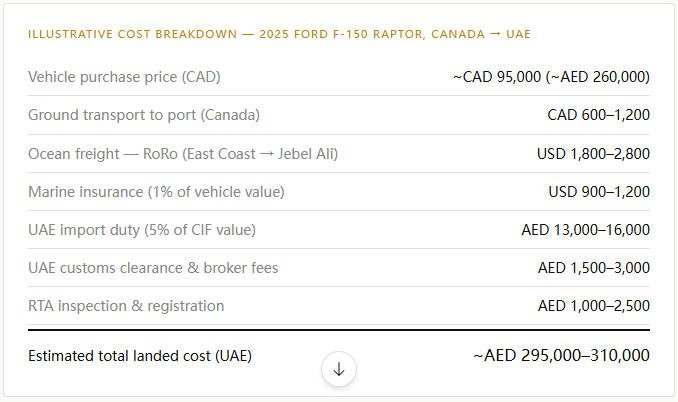
For comparison, the F-150 Raptor listed through UAE official Ford dealerships typically starts above AED 362,145 — meaning a well-managed Canadian export order can represent a meaningful price advantage, even after all logistics and import costs are included.
North American Spec vs GCC Spec: What UAE Buyers Need to Know
This is the question that comes up in every conversation with a first-time buyer. Canadian-spec (North American-spec) vehicles are built for the North American market. GCC-spec vehicles are built specifically for Gulf conditions. There are real differences, and buyers should understand them before ordering.
Cooling systems. GCC-spec vehicles have enhanced cooling systems — larger radiators, stronger AC compressors — designed for extreme heat. North American-spec vehicles are not optimised for sustained 45°C+ temperatures. For UAE buyers planning heavy summer use or desert driving, this is a genuine consideration.
Warranty. A vehicle sourced from Canada will not carry a UAE manufacturer warranty. Warranty from the Canadian dealer does not transfer internationally. Some buyers manage this by purchasing extended third-party mechanical warranties; others accept it as a known trade-off for the price difference and specification access.
Fuel type and octane. Most North American trucks run on regular or premium unleaded petrol, which is widely available in the UAE. This is rarely an issue in practice.
RTA inspection requirements. North American-spec vehicles require a UAE RTA technical inspection before registration. In most cases, vehicles pass without modification. Occasionally, minor lighting or reflector adjustments are required.
For B2B dealers importing into the UAE for resale, North American-spec vehicles are well understood by the market and trade confidently in the UAE’s active parallel-import sector.
People Also Ask
Total timeline from vehicle purchase to UAE delivery is typically 6–10 weeks. This includes 1–2 weeks for dealer processing and transport to port, 28–35 days ocean transit (East Coast Canada to Jebel Ali), and 1–2 weeks for UAE customs clearance and RTA registration. Buyers sourcing in-stock vehicles move faster; factory orders add 4–12 weeks before the clock starts.
Yes. The UAE allows import of left-hand drive, North American-spec vehicles through Jebel Ali Port. The vehicle must pass an RTA technical inspection upon arrival. Import duty of 5% of the CIF value applies. There are no blanket restrictions on Canadian or US-spec vehicles, though individual models may face specific compliance requirements.
In practice, yes. While it is technically possible to self-clear, the UAE customs process at Jebel Ali involves multiple authorities — UAE Customs, the RTA, and potentially ESMA for vehicle compliance. A licensed customs broker manages the documentation submission, inspection scheduling, and duty payment efficiently and significantly reduces the risk of delays.
Yes, and batch importing is common among UAE parallel-import dealers. Importing multiple units in a single container or on the same RoRo vessel reduces per-unit logistics costs. B2B buyers working with a Canadian export supplier regularly place orders for 2–10 units at a time, with documentation processed as a single commercial shipment.
Marine insurance — covering the vehicle from the moment it leaves the Canadian dealership to delivery in the UAE — is mandatory and covers physical damage during transit. Claims are handled through the insuring underwriter. For this reason, buyers should ensure the pre-shipment inspection report is thorough and photographic, as it establishes the vehicle’s condition at origin and forms the basis of any damage claim.
Most standard passenger vehicles, trucks, and SUVs can be exported. Exceptions include vehicles under certain manufacturer export holds (some brands restrict export of new vehicles within the first 12 months of purchase), salvage-title vehicles, and models with active safety recalls that have not been resolved. Your Canadian export supplier should screen for all of these before purchase is confirmed.