
In the sector of global automotive trade, 2026 marks a pivotal shift toward regulatory precision. According to the BCG (Boston Consulting Group) 2026 North American Trade Outlook, the deepening of USMCA 2.0 protocols and heightened traceability for Electric Vehicles (EVs) have made “Regulatory Compliance” the definitive line between profit and seizure.
As a specialized North American exporter, CCE Auto recognizes that B2B buyers often struggle with complex customs and multimodal logistics. To mitigate risk, we have deconstructed the export process into five core steps aligned with 2026 industry standards.
Precision Sourcing & Market Access Compliance
Acquiring a high-quality vehicle in North America is only the beginning; ensuring it can be legally registered at the destination port is the objective. A recent Auto Vision LLC global survey highlights that in 2026, markets across the Middle East, Central Asia, and Africa have significantly tightened emission standards, with many now synchronizing with Euro 6 benchmarks.
CCE Engineering Practice: During the procurement phase, we verify the EPA (Environmental Protection Agency) label and the production date against the destination country’s specific policies. If a vehicle’s Model Year (MY) prevents local registration, we advise against the purchase to protect client capital.
Core Document Auditing & Title Pre-Screening
Possessing the Certificate of Title is insufficient for U.S. Customs and Border Protection (CBP). Under the strict mandates of 19 CFR 192.2, all vehicles intended for export must have their original ownership documents submitted to CBP at least 72 hours prior to export.
Risk Mitigation: Any attempt to bypass this mandatory 72-hour “cooling-off period” results in port seizures or heavy fines. The CCE Auto documentation team utilizes the AES (Automated Export System) to file electronically, ensuring the vehicle’s identity is legalized before it even reaches the port.
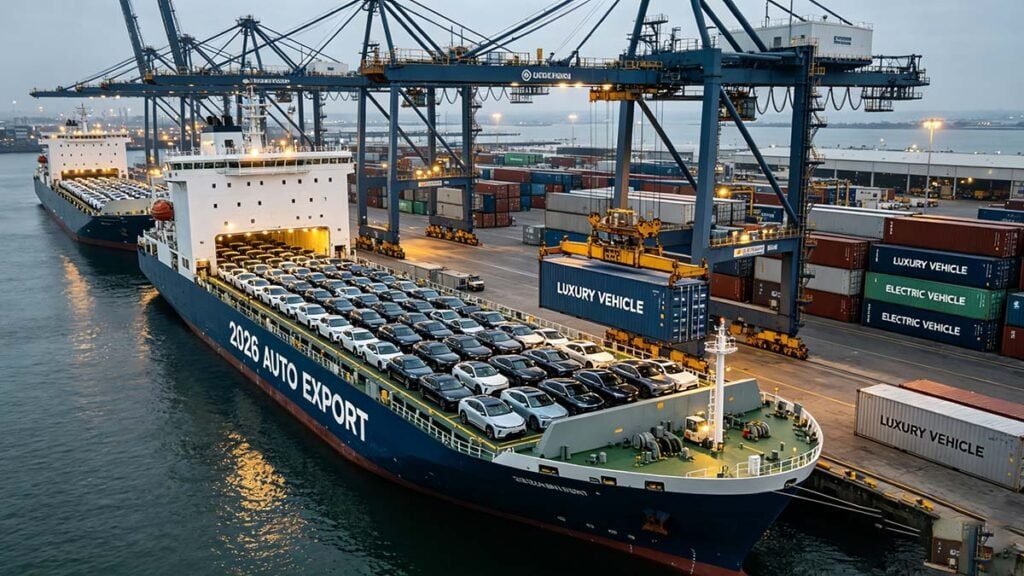
2026 Smart Logistics—Ro-Ro vs. Containerization?
As per Ship Overseas operational guidelines, the 2026 shipping market remains volatile due to geopolitical shifts.
Ro-Ro (Roll-on/Roll-off): Ideal for high-volume, standard-sized units at the lowest cost-per-unit, provided the destination port supports it.
Container Shipping: Best for high-value luxury units or EVs requiring superior physical protection.
Customized Solutions: At CCE Auto, we tailor logistics based on real-time freight rates and route stability—monitoring the impact of Red Sea tensions on Middle Eastern routes—to ensure “Arrival as Inspected”.
Vehicle Preparation & Safety Compliance
Often overlooked, this stage is a primary focus for customs inspections. International maritime safety conventions require specific transport states: fuel levels must not exceed 1/4 tank, and battery disconnections must follow protocol. For used EV exports in 2026, a State of Health (SoH) report has become a “soft requirement” for clearance in several emerging markets.
Port of Destination Clearance & Document Integration
The goal of export is a “frictionless” handover at the destination. We provide a comprehensive document package via DHL, including the original CBP-stamped Title, Commercial Invoice, and Packing List. Aligning with the 2026 digital filing trend, we provide synchronized digital copies to your local customs broker for rapid vehicle release.
The CCE Auto Professional Commitment
As the BCG report indicates, automotive trade in 2026 has transitioned from a “competition for resources” to a “competition over rules.” CCE Auto is not merely your sourcing partner in North America; we are your navigators through complex international policy.
Get Ahead of the 2026 Market
Ready to access the latest North American inventory with real-time freight estimates?