
A market-focused overview of Toyota’s position across African markets, key model demand, competitive pressure, and the next stage of growth for importers and B2B dealers.
Toyota’s Foundation in Africa: Long-Term Market Presence, Not Short-Term Popularity
Toyota’s acceptance in Africa did not appear overnight. According to Toyota Global’s historical records, the company began exporting Land Cruiser models to African countries such as South Africa, Nigeria, and Angola in the late 1950s. Over time, Toyota built a sales network across multiple African markets. Official records show that Toyota’s sales network now covers 53 African countries, which reflects a long-standing channel base rather than a business model driven only by short-term import demand.This established infrastructure makes Toyota the most reliable brand for vehicle sourcing in the region.
From a product perspective, the Land Cruiser was one of the earliest Toyota models to build a strong reputation in Africa. Toyota Global notes that the first Toyota vehicle exported to South Africa in 1959 was a Land Cruiser. Later, Land Cruiser models were also assembled in markets such as Kenya. This matters because in Africa, the Land Cruiser is valued not only as a premium SUV, but also as a dependable, durable, purpose-built vehicle that can handle rough roads and demanding operating environments.
South Africa: One of Toyota’s Strongest African Markets
South Africa is one of the most developed and representative vehicle markets on the African continent, making it an important reference point for understanding Toyota’s broader regional performance. According to Business Report’s August 2025 coverage, South Africa recorded 51,383 new vehicle sales in July 2025, up 15.6% year over year. Toyota South Africa Motors secured a 24.7% market share, maintaining a clear leadership position in the market.
Toyota’s strength is not built on a single model. The brand performs across passenger cars, light commercial vehicles, and medium commercial vehicles. The same report noted that Toyota sold 12,694 units in South Africa in July, including 12,257 Toyota-branded vehicles, 84 Lexus vehicles, and 353 Hino units. This shows that Toyota’s footprint in South Africa reaches beyond private consumers and extends into business, commercial, fleet, and logistics use cases.
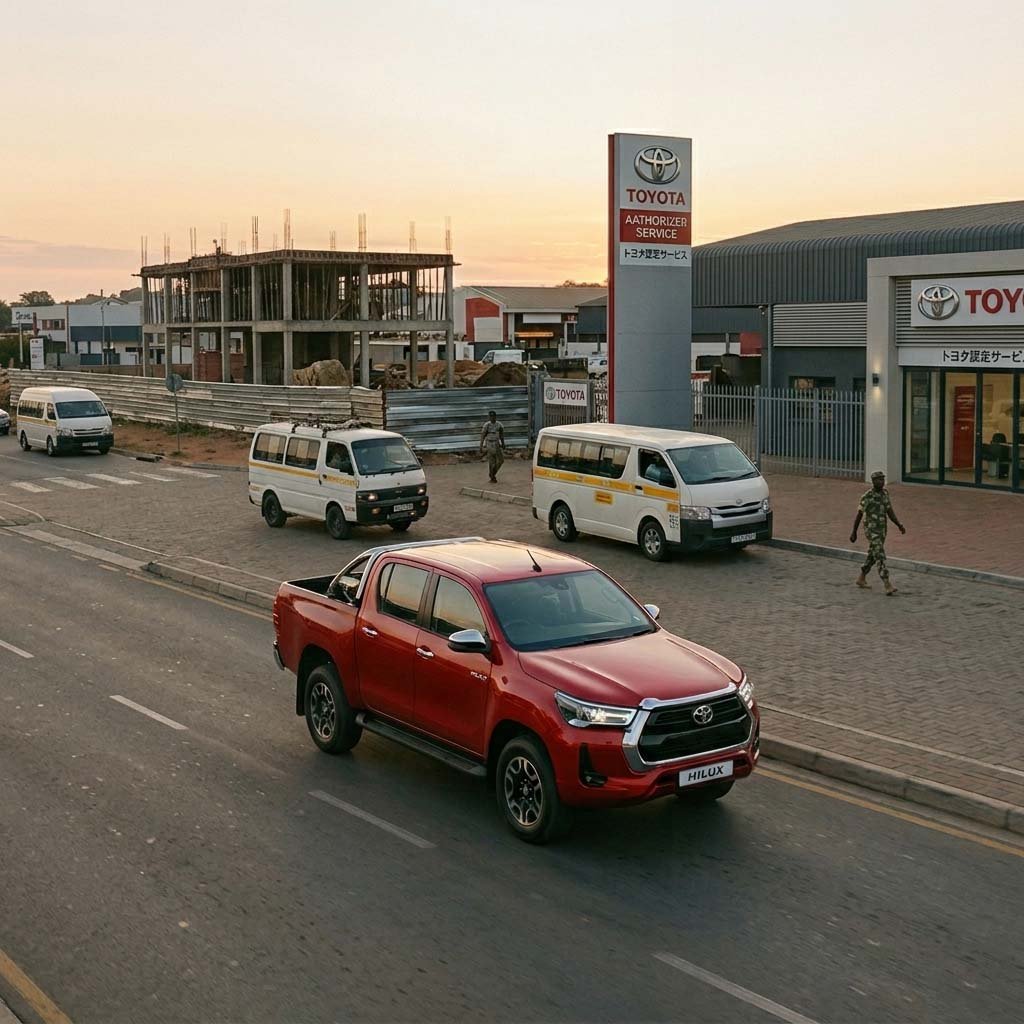
Hilux: One of the Most Representative Toyota Models in Africa
If one model best represents Toyota’s market acceptance in Africa, the Toyota Hilux is clearly among the strongest candidates. Business Report stated that Hilux sold 3,120 units in South Africa’s light commercial vehicle segment in July 2025, reaching a 26.8% segment share and remaining the country’s overall best-selling vehicle.
The reason Hilux performs so well in Africa is straightforward: it works across multiple use cases. It can serve as a family vehicle, a business transport tool, a project vehicle for construction and engineering, a farm vehicle, a mining-site workhorse, or part of a government or corporate fleet. In many African markets, durability, ease of maintenance, and parts availability are more important than luxury features alone. That is why the value of Hilux comes not only from the product itself, but also from Toyota’s long-established service network, parts supply, and brand trust.
Land Cruiser, Hiace, Fortuner and Other Models Strengthen Toyota’s Position
Beyond Hilux, Toyota has several other strong models in South Africa and across the wider African market. Business Report mentioned that the Toyota Hiace ranked fifth in the light commercial vehicle category, while the Land Cruiser 79 Pick-up ranked sixth. The Land Cruiser Prado also recorded noticeable sales growth. This shows that Toyota’s strength in Africa covers several demand segments, including commercial transport, off-road use, premium SUVs, and family SUVs.
Toyota’s acceptance is also clear in East Africa. Auto24 Rwanda reported that Toyota continues to hold a leading position in the region, with models such as Hilux, Land Cruiser, and Corolla remaining popular due to durability, fuel efficiency, and suitability for local road conditions. This aligns closely with real-world driving conditions in many African countries, where road quality can vary significantly, repair resources may be unevenly distributed, and buyers often place high value on long-term ownership cost and resale value.
Ideal for mining-site workhorses, government fleet supply, and engineering project vehicles.
Toyota’s Product Mix in Africa: From Durable Work Vehicles to SUVs and Hybrids
Toyota’s traditional strength in Africa has been built around models such as Hilux, Land Cruiser, Hiace, and Corolla. In recent years, however, the product mix has started to evolve. South African market data shows visible sales momentum for models such as Corolla Cross, Starlet, Fortuner, and Starlet Cross. Business Report noted that in July 2025, Corolla Cross sold 1,949 units, Fortuner sold 984 units, and Starlet Cross sold 757 units.
This suggests that Toyota’s acceptance in Africa is expanding from traditional utility-focused vehicles into more urban, family-oriented, fuel-efficient SUVs and crossover models. For importers and dealers, this means future opportunities in Africa may not be limited to Hilux and Land Cruiser. Models such as Corolla Cross, Fortuner, Prado, RAV4, and Highlander may also see stronger demand as consumer needs become more diversified.
New Energy Trend: Toyota Has an Edge in Hybrids, While EVs Still Face Barriers
Over the next few years, Africa’s automotive market will also be influenced by the shift toward new energy vehicles. However, the pace of adoption is likely to be slower than in Europe, China, and North America. Reuters reported in 2025 that Toyota planned to introduce three fully electric models to South Africa in early 2026, marking an important step into the country’s EV market. At the same time, Toyota already held a 67% share of South Africa’s hybrid and plug-in hybrid market, supported mainly by models such as the Corolla Cross. As a leader in African green mobility, Toyota’s Hybrid SUV export opportunities are expanding rapidly.
That said, full EV adoption in Africa still faces real constraints. Reuters also noted that EV growth in South Africa is limited by factors such as lower income levels, high import duties, unstable power supply, and insufficient charging infrastructure. As a result, hybrids may be accepted more quickly than pure electric vehicles in the short to medium term.
Competitive Landscape: Chinese Brands Are Expanding, but Toyota’s Brand Trust Remains Strong
Toyota will not face the future African market without competition. Reuters reported in 2025 that Chinese automakers such as BYD, Chery, and Great Wall Motor are accelerating their expansion into Africa, with South Africa receiving particular attention as a gateway to the wider continent. The report also noted that South Africa has long been dominated by traditional brands such as Volkswagen and Toyota, while Chinese brands are now seeking growth through pricing, hybrid technology, and electric vehicle offerings.
Even so, this does not mean Toyota’s advantage will disappear quickly. Reuters also pointed out that Chinese brands in Africa still face consumer concerns around quality, parts availability, and used-car resale value. These are exactly the areas where Toyota has built long-term strength. For African consumers and B2B dealers, a lower purchase price matters, but long-term durability, easy repairs, resale value, and stable parts supply often play a larger role in the final buying decision.

Future Outlook: Toyota Still Has Long-Term Opportunities in Africa
Overall, Toyota’s future in Africa remains positive. First, the brand has built more than half a century of market presence on the continent, supported by a broad sales network and strong brand recognition. Second, models such as Hilux, Land Cruiser, Hiace, Fortuner, and Corolla Cross cover commercial use, off-road demand, family transport, urban SUV needs, and hybrid mobility. This product structure fits Africa’s diverse vehicle requirements very well. Third, although Chinese brands will bring stronger price competition, Toyota still holds a clear advantage in reliability, resale value, maintenance convenience, and parts availability.
For North American vehicle exporters and B2B dealers, the Toyota models most worth watching in African markets include:
- Hilux: Commercial transport, engineering projects, agriculture, fleet use, and multi-purpose personal demand.
- Land Cruiser / Land Cruiser 79: Off-road use, government fleets, mining sites, energy projects, and premium utility demand.
- Fortuner / Prado: Family SUV demand and mid-to-high-end import vehicle markets.
- Hiace / Coaster: Passenger transport, commercial mobility, and corporate fleet operations.
- Corolla / Corolla Cross: Urban families, ride-hailing, daily commuting, and fuel-efficient mobility needs.
In the coming years, Toyota’s African market is likely to move in three directions. First, demand for traditional gasoline and diesel models will remain strong. Second, hybrid demand will continue to grow gradually. Third, pure electric vehicles will likely begin with more mature markets such as South Africa, but in the short term they are unlikely to replace gasoline, diesel, and hybrid models as the mainstream choice.
Suggestion from CCE Auto
For global importers and dealers, Toyota remains one of the most reliable product lines for African markets. From Hilux and Land Cruiser to Fortuner, Prado, and Corolla Cross, CCE Auto helps B2B clients source verified North American inventory with transparent pricing, secure payment, and export-ready documentation.
CCE Auto provides verified North American inventory with export-ready documentation and secure B2B payment solutions for African dealers.
[Contact CCE Auto Trade on WhatsApp] for our latest 2026 Price List and real-time inventory updates.