
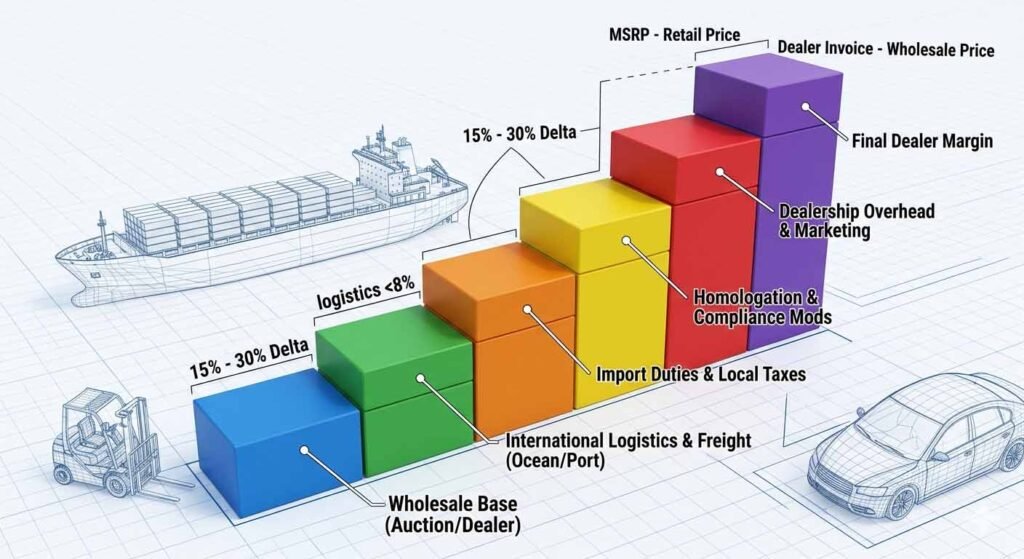
In the international automotive market—specifically within the high-growth corridors of the Middle East, South America, and Africa—understanding the delta between wholesale and retail car prices is the foundation of a sustainable export-import (EXIM) business. This guide analyzes the structural cost layers, from port-to-port logistics to final market distribution.
Defining the Core Pricing Structures
Wholesale Price (The “B2B” Layer)
Wholesale pricing is the bulk rate at which vehicles are sold to licensed dealers, exporters, or large-scale fleet managers.
- Key Characteristic: It is typically close to the Manufacturer’s Invoice Price or the auction clearing price.
- The Delta: Wholesale prices are generally 15% to 30% lower than retail, reflecting the absence of individual marketing costs and dealership overhead.
Retail Price (The “MSRP” Layer)
The retail price, or the Manufacturer’s Suggested Retail Price (MSRP), is what the end-user pays at a local showroom.
- Key Characteristic: It incorporates the “Landage” costs, dealer margins, and local consumer protections.
The “Hidden” Cost Bridge: Why the Gap Exists
For a B2B operator like CCE Auto Trade, the difference between wholesale and retail isn’t just profit; it’s a complex chain of “Value-Added Costs” (VAC).
- Logistics & Multimodal Transport: Moving a vehicle from North American inventory to Dubai (Jebel Ali) or Lagos ports involves ocean freight, port handling, and terminal charges.
- Compliance & Homologation: Each target market has specific safety and emission standards. Modifying a vehicle to meet these requirements adds to the retail price.
- Inventory Carry Costs: Capital is tied up during the 30–45 day shipping window. Wholesale buyers absorb this risk, which is why they receive a lower entry price.
Technical Comparison: Wholesale vs. Retail ROI
we use a data matrix to compare the two pricing models:
| Financial Metric | Wholesale / Export (B2B) | Local Retail (B2C) | ROI Implication |
| Transaction Volume | Bulk (10 – 100+ units) | Individual (1 unit) | Wholesale leverages scale. |
| Price Stability | Volatile (Market Auction driven) | Stable (Set by MSRP) | Retail offers fixed margins. |
| Risk Factor | Shipping & Exchange Rate Risk | Consumer Credit & Warranty Risk | Divergent risk profiles. |
| Average Margin | 5% – 8% (High Velocity) | 12% – 20% (Low Velocity) | Wholesale relies on “Turnover.” |
Market-Specific Variables: Middle East and Africa
The delta between wholesale and retail fluctuates based on regional trade agreements:
- Free Trade Zones (FTZs): In markets like the UAE, wholesale trade within FTZs avoids initial VAT/Customs, creating a massive price gap compared to re-registered retail units.
- Import Duties: In South American markets with high protectionist tariffs, the retail price can be double the wholesale export price due to local luxury taxes.
FAQ: Addressing Global Trade Pain Points
Q1: Can an individual buyer access wholesale pricing?
Generally, no. Access to wholesale auctions and manufacturer invoice pricing requires a valid dealer license and, often, a minimum annual volume commitment.
Q2: What is the impact of “Export Titles” on the wholesale price?
In North American markets, a “Clean Title” vehicle commands the highest wholesale value. However, vehicles destined for export in the Middle East or Africa are often sourced via Export-Only Titles. These units avoid certain local registration taxes, allowing exporters to secure a lower entry price, which widens the margin when sold at retail in non-US jurisdictions.
Q3: How does the difference between FOB and CIF affect the final landed cost?
Wholesale prices are often quoted as FOB (Free On Board), meaning the buyer assumes all risks once the car is at the exit port. For retail-ready calculations, you must use CIF (Cost, Insurance, and Freight). The gap between wholesale and retail often narrows or widens based on current ocean freight volatility; a spike in container rates can absorb up to 5% of the expected retail margin if not hedged correctly.
Q4: Can B2B buyers reclaim VAT on wholesale vehicle purchases?
This depends on the jurisdiction. In the EU and certain Middle Eastern Free Zones (like DUCAMZ), vehicles intended for immediate re-export are often exempt from VAT or eligible for a full VAT recovery. This “tax alpha” is a key reason why wholesale export prices appear significantly lower than local retail prices, which include non-refundable consumer VAT.
Q5: Why do some “Brand New” cars sell for more than MSRP in retail markets?
This is known as “Market Adjustment” or “Premium Pricing.” In regions with supply chain constraints (common in South America or West Africa), high-demand models—such as the Toyota Land Cruiser or high-spec EVs—can retail for 20-40% above the wholesale invoice price because of immediate availability (“Ready Stock”), whereas wholesale orders may have a 6-month lead time.
Q6: How does currency fluctuation (e.g., USD vs. BRL or NGN) affect the price gap?
Wholesale trades are almost exclusively conducted in USD. If a local currency devalues against the dollar, the retail price in that country will skyrocket to cover the replacement cost, even if the wholesale price in the US remains static. Successful B2B exporters use “Forward Contracts” to lock in the wholesale-to-retail conversion rate.
Why Partner with CCE Auto Trade?
Navigating the border between Canadian and US supply chains requires more than just a buyer; it requires a logistics expert. Whether you are sourcing a fleet of Cadillac Escalade IQs or a single Porsche Carrera T, we provide:
VIN Verification & History Reports.
Secure Multi-Unit Container Loading.
Metric/Imperial configuration support.
Ready to upgrade your inventory?
[Contact CCE Auto Trade on WhatsApp] for our latest 2026 Price List and real-time inventory updates.